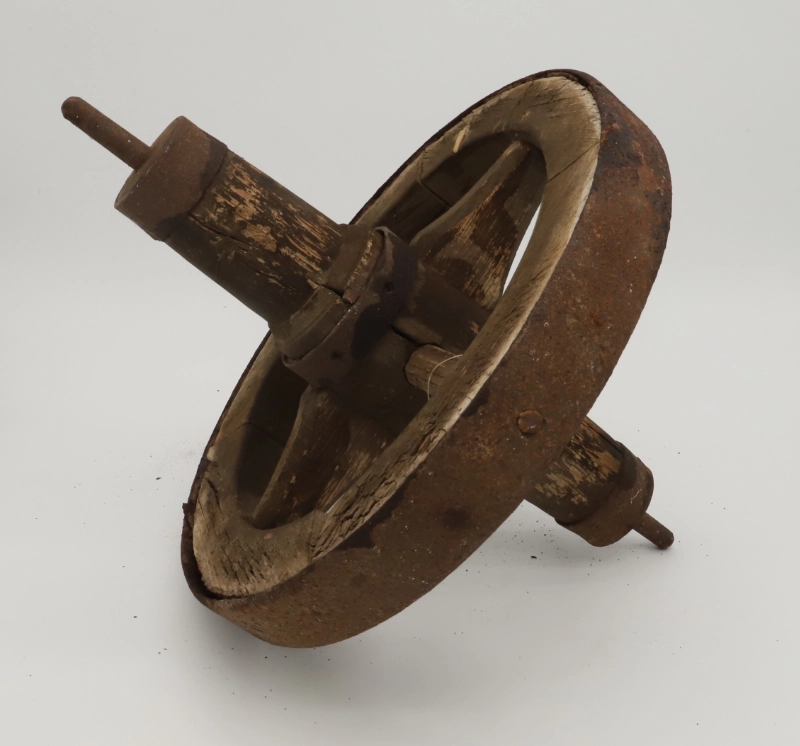
cart wheel
Inventory Number: 2026/006
Origin: The Kraetzer Family, Altwriezen – Frankfurt/Oder
Diameter:
Deposit:
> weitere Informationen
The Kraetzer family lived in Altwriezen for centuries; a settler’s charter establishing the rights to use the farmland dates back to the year… In 2026, the museum received a number of items from the liquidation of their farm. This wheel was part of a once-indispensable handcart, a predecessor to today’s rubber-tired wheelbarrows. It made daily farm work easier, as loads had to be moved constantly.
Axel Kraetzer writes: „An integral part of a transport vehicle, it crisscrossed the farmyard and the garden. It carried sacks of grain, but also feed—namely, freshly cut „greens“ (grass, clover, or alfalfa). In winter, it carried feed potatoes and beet pulp, which were freshly ground every day. Of course, manure from the barn also had to be transported with it.“
The wheel dates from a time when nearly every village still had its own wheelwright and blacksmith, and almost all the tools needed for farm work were produced right there on the spot. It is therefore highly likely that this cartwheel was made by the Altwriezen blacksmith Seefeldt (Altwriezen, House No. 5) and wheelwright Haefker (Altwriezen, House No. 7) in the early 20th century: „The wooden parts are all made of oak. The wheel and the hub were made on a lathe. After the wheelwright had finished the wooden wheel, it was sent to the blacksmith. He crafted the rim and the rings on the hub. These were not made to fit exactly, but were made narrower than the diameters of the wheel and hub. To fit them onto the wood, they were heated. This caused the iron to expand, allowing it to be easily pulled onto the wheel and hub. After cooling, the rim and rings „contracted“ again. In other words, cooling caused them to shorten in length. This could even be calculated. Here, however, it was centuries-old experience that had been passed down through the generations.“ (Kraetzer, 2026)
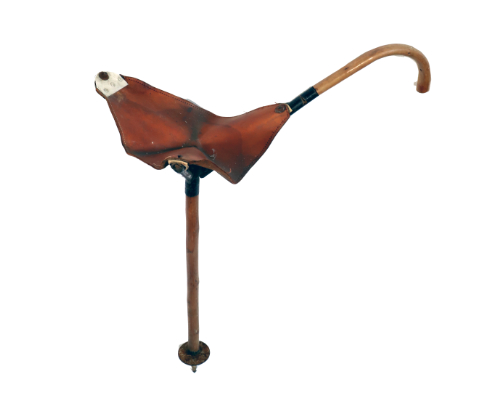
Seat post
Inventory Number: 2026/013 (A)
Origin: Herbert Woidke from Gieshof/Zelliner Loose, donation from Nadja Hirsch
Height: 98 cm
Deposit: Attic Textiles
> weitere Informationen
This wooden and leather walking stick comes from the estate of Herbert Woidke of Gieshof/Zelliner Loose. He used it on his fishing and hunting trips, both as a walking stick and as a seat. Hunters and anglers sometimes have to wait a long time, and this stick makes that time more comfortable. The object thus reflects travel on foot and extended stays in the great outdoors. The disc at the lower tip prevents it from sinking into the ground. The item is carefully and solidly crafted, so that it can still serve its purpose perfectly today.
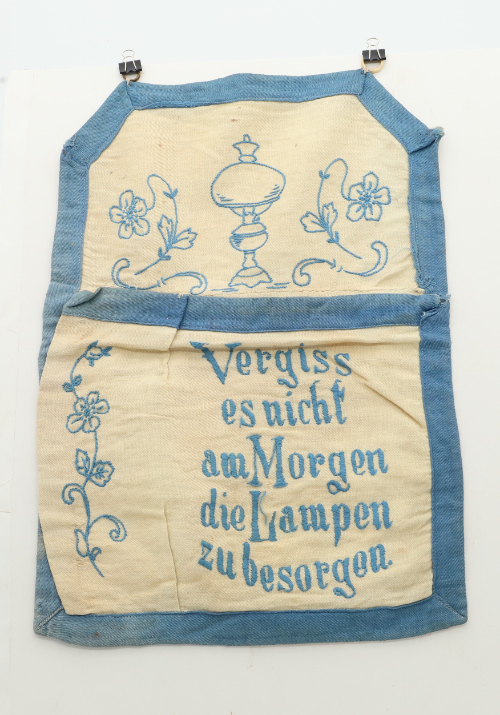
Cloth Pouch for Kerosene Lamp Accessories
Inventory Number: V 4888
Dimensions: 38 x 26 cm
Deposit: Textile Magazine
Origin: Ursula Schulz, 15366 Neuenhagen near Berlin, added to the collection on July 30, 1989
> weitere Informationen
The utensil holder is a blue-embroidered fabric pouch made of white cotton. The purpose of this lovingly embroidered item is described by the inscription: „Don’t forget to get the lamps in the morning.“ It was therefore used to keep supplies for cleaning and maintaining oil lamps (wicks, matches, scissors for trimming wicks, or cleaning rags) within easy reach.
Numerous embroidered kitchen towels and utensils inscribed with words of wisdom, maxims, and sayings have been preserved from the late 19th and early 20th centuries. They point to a time when the kitchen was no longer merely a place of work for subsistence, but was also discovered as a space for expressing one’s lifestyle.
Before electrification, kerosene lamps were still the standard form of lighting in households. Unlike the incandescent bulbs that came later, they required more care and maintenance: soot had to be removed, fresh kerosene had to be added, and the wick had to be checked. Light sources prepared in this way functioned independently of a gas or electricity grid and thus exemplify an era when energy use was still integrated into a local subsistence economy.
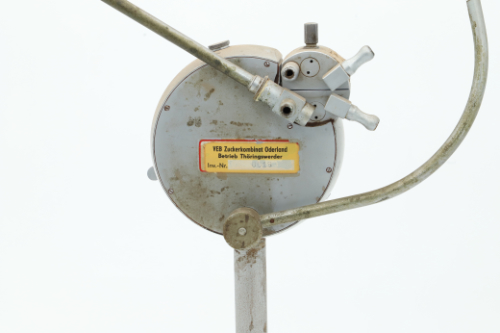
Food Refractometer
Inventory Number: VI 3667 A
Height: 40 cm
Deposit: Attic
Origin: VEB Oderland Sugar Complex, Thöringswerder Plant
> weitere Informationen
This refractometer was used to measure the sugar content in a solution. The inventory label dates back to the 1960s, when the Thöringswerder and Voßberg sugar factories were merged.
A food refractometer is an optical measuring device used to determine the concentration of dissolved substances—usually sugar—in liquids. The more sugar (or other dissolved solids, such as salt) the liquid contains, the more the light is refracted. This refractive index is measured by the refractometer and converted to a readable scale, often the Brix scale (1 degree Brix corresponds to 1 gram of sugar in 100 grams of solution). The sugar content is expressed as a percentage.
Refractometers are still used today in food production for quality control, for example, to measure the sugar content in fruit, juices, jam, and wine (must weight) or to determine the water content in honey.
Sugar production has been of extraordinary historical significance for the Oderbruch region. Established here by the Prussian agricultural reformer Johann Gottlieb Koppe (1782–1863)—from cultivation to industrial processing—the sugar beet remained a key crop with direct regional processing even during the GDR era. By the end of the GDR era, sugar beets were being grown on 10,000 hectares. The pressure on production due to industrial production targets was enormous at that time.[1]. Back then, school classes and work collectives in the Oderbruch region were required to go out into the fields to thin the beets. Almost everyone from the Oderbruch who lived here during the GDR era has memories of these work assignments.
After German reunification, sugar beet cultivation saw dramatic increases in yields thanks to new technologies, but at the same time, the processing industry collapsed. As a deep-rooted root crop, the sugar beet is very useful for crop rotation; however, the EU cultivation quotas for this crop expired, and transportation costs for processing at the Könnern facility in Anhalt were very high. Today, sugar beets are grown only sporadically for use in biogas plants. Currently, sugar beets can still be found on only about 200 hectares of Oderbruch soil.
[1] Interview with Jörg Berndt, Head of Production and Technology in Thöringswerder from 1977 to 1983 and, beginning in 1990, a crop advisor for sugar beet production, on July 13, 2026.