

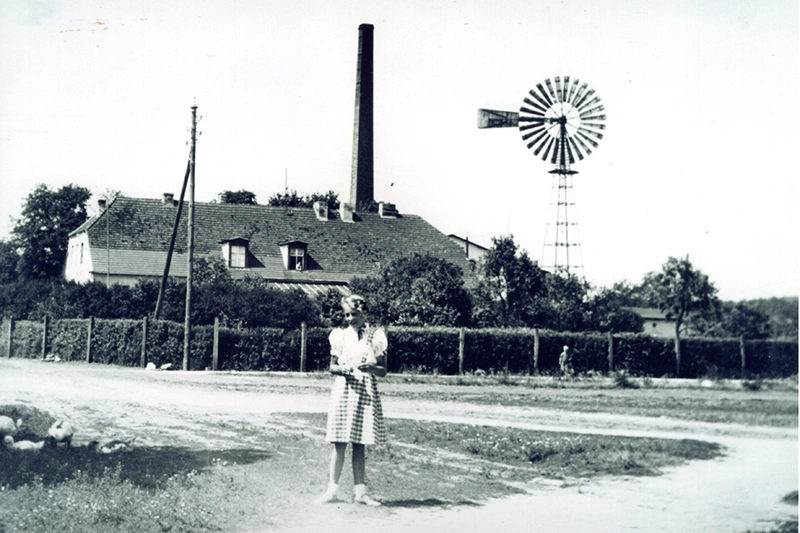
Without energy, nothing works, no appropriation of space succeeds, no community grows, no house, no farm, no village, no society, no landscape gains its special shape.
There are various energy sources and energy stores: us humans, livestock and crops (renewable in the fields and in stables as well as coagulated in oil, coal and gas), there is water, wind and sun, geothermal energy, biogas... Many technical solutions have been invented to make energy in its various forms usable for us humans and to bring it to the places where energy is needed for our lives. Everyone is talking about renewable energies and their growth, but hardly anything about the activities for which this energy is needed.
What did the energy situation in the Oderbruch look like yesterday and the day before yesterday, what does it look like today and what might it look like in the future? With the annual theme of ENERGY, we want to go on a search for clues as to how the energy conditions in the Oderbruch have developed, what forms can be found today and ask what would be desirable in the future.
We want to search for traces of the elements of the energy system in the Oderbruch:
Where can historical elements still be found: horse-drawn carts with transmission, old windmills, water mills, is there still a wood gasifier truck, a steam plow? Lignite mining near Bad Freienwalde, which continued until after the war, is also part of the story. Was peat cut for fuel?
Are there places where the power of natural energy can be seen: a lake scoured out by floods, a wind vanishing on a hill at the edge of the Oderbruch or solitary in the wide landscape, sandbanks in the Oder, debris from the Old Oder (the "Rähnen"), a wind break?
What do the current elements of the energy system in the Oderbruch look like? Where are individual wind turbines, where are groups of wind turbines, where was the first wind turbine in the Oderbruch? Where are there photovoltaic systems, on roofs, in gardens, in fields... Transformer stations, overhead lines, storage facilities etc. are needed to transport this energy and, if necessary, to store it. What about biogas plants? Where do heat and electricity go? Are they part of agricultural cycles, do they feed municipal district heating networks like in Neutrebbin?
How high is the maize, does it process better when dried in the field? Which plants are still used for energy production? Are there short rotation plantations in the Oderbruch?
Do sugar beets for energy production look different from those for raw sugar?
People are always part of energetic systems: What does their work in the systems look like? What does a mechatronics technician who maintains wind turbines do, what does an agricultural machinery technician do at the biogas plant, what is the best way to chop wood for the stove, what is it like to live in a zero-energy house, and what does this house look like? How is a wind turbine built? How does a company that installs photovoltaic and solar systems or heat pumps work? Who still makes firewood from landscaping or their forest? Where do gas and oil pipelines run and how can you recognize their route? What has become of the oil production at the Kietz deposit near Neumanschnow, does oil and gas still flow here and where does it go? Which farmer still uses live horsepower? Is there anyone who has built their own small wind turbine? What is it like to live in the middle or on the edge of energy production plants?
What spatial conflicts over the use of energy have there been, what are there and are new ones to be expected? Is CO2 injection (CCS technology) as a result of carbon combustion definitely off the table for the Oderbruch? When does the Oderbruch landscape run the risk of the energy production plants changing its historical legibility? When does a cultural landscape become an energy landscape - or is the cultural landscape worth protecting as a construct of nature and heritage conservation precisely because industrial energy production has not yet found a starting point here?
Is there a human measure for shaping energy conditions in the Oderbruch? What would it look like?
More on the 2026 annual program soon
A collection of over 100 pages on the annual topic of ENERGY
you will find here.
This collection provides insights from different perspectives on various topics and does not claim to cover the broad field of energy and landscape in the Oderbruch in its entirety. It is a prelude.